
Proteins

Proteins, proteomics

Proteins and Proteomics
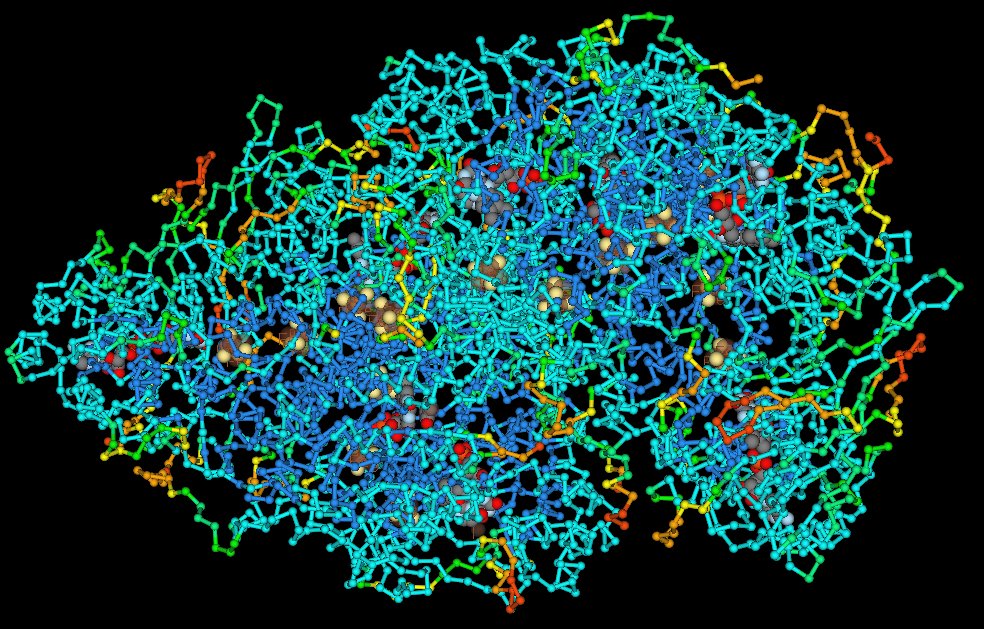
Proteins are complex, macromolecules comprised of amino acids linked by peptide bonds into long chains. The sequence (primary structure) and properties of constituent amino acids generate the 3D conformational structure (tertiary and quaternary structure) that is vital to the biological function of proteins. (click to enlarge image)


Proteins are essential to the structure and biological viability of all living cells and viruses. The cellular proteome is the total cellular protein under a particular set of conditions, while the complete proteome is the sum of all potential proteomes of a cell. Proteomics has become the subject of much research in cell and molecular biology.

Proteins play a number of vital roles as:
a. Enzymes or subunits of enzymes – catalyzing cellular reactions.
b. Structural or mechanical roles – structural components of tissues, components of the cytoskeleton, centrioles, cilia and flagella, microtubules, molecular motors.
c. Intracellular and intercellular signaling functions – ion channels, receptors, membrane pumps.
d. Regulatory proteins or adaptor proteins in genetic transcription, RNA processing, spliceosomes.
e. Products of immune and inflammatory responses that aid in targetting of foreign substances and organisms.
f. Storage and transport of various ligands.
g. The source of essential amino acids.

Almost all natural proteins are encoded by DNA, which is transcribed and processed to yield mRNA, which then serves as a template for translation by ribosomes on the rough endoplasmic reticulum.

Protein roles:
● cytoskeletal protein, enzymes, ion channels, latent gene regulatory proteins, receptor proteins, 'signaling' enzymes, signaling proteins, transcription factors
● activator,
● adaptor protein, amplifier protein, anchoring protein, bifurcation protein, coincidence detector protein, effector protein, messenger protein, modulator protein, relay protein, scaffold protein, transducer protein

Specific proteins/types : § adaptor protein : cAMP receptor binding protein § CARD domains : cofactor § collagen : core histones H2A, H2B, H3, and H4 : CRE-binding protein CREB § C-reactive protein § CRP § domains : elongation factor EF § granulysin : helicases : Helicase II : heterochromatin : histone : HP1 § immunoglobulin isotypes : inducible transcription factors : LexA repressor : mCAT2 receptor : motor proteins § NF-κB : nucleosome : PcG proteins : PCNA § (pentraxins, CRP) § PH family : Polycomb group : proteome : RecA : regulatory proteins : repressor proteins : ribosomes : RPA : serine rich (SR) splicing factors : silencers : Ski7p : small nuclear ribonucleoproteins (snRNPs) : spliceosome : SR (serine rich) splicing factors : trans-acting factors : trithorax group (trxG) : UPF1 UPF2 : upstream transcription factors :

Enzymes ♦ Enzymes : ♦ activation-induced (cytidine) deaminase ♦ adenylate cyclases ♦ AID ♦ Akt : AP endonuclease (Ape1) ♦ ATPases ♦ bonds ♦ cAMP-dependent protein kinase ♦ cyclin-dependent kinases : DNA glycosylase : DNA Ligase I : DNA polymerases : DNA polymerase I : DNA polymerase beta : DNase IV ♦ energetics : exonuclease 1 : exosome : Fen1 : Flap Endonuclease FEN-1 ♦ Fyn : general transcription factors ♦ GTPases : hOGG1 : hOGG1 oxoG repair : LigIII : MAP kinase ♦ MAPKs ♦ MEK ♦ MPF : Msh2-Msh3 ♦ mTOR : MutS, MutL, and MutH : 8-oxoguanine glycosylase : oxoG repair hOGG1 : PCNA ♦ PDK1 ♦ PTEN ♦ PDK1 ♦ phosphatases ♦ phospholipases ♦ phosphodiesterases ♦ phosphorylases ♦ PIKK ♦ PI3K ♦ PKA ♦ PKB ♦ PKCs ♦ protein kinases ♦ reaction energetics ♦ receptor tyrosine kinases : RNA polymerase: Replication factor C : reverse transcriptase : ribozymes : RNA polymerase II ♦ serine/threonine kinases : spliceosomal-mediated RNA trans-splicing SMaRT : trans-splicing ribozymes ♦ UNG2 ♦ uracil-DNA glycosylase : UvrD : XRCC1 :

[] Rediscovering Biology - Animations and Images []

Alphabetic links to Glossary items:◦ A ◦ B ◦ C ◦ D ◦ E ◦ F ◦ G ◦ H ◦ I ◦ J ◦ K ◦ L ◦ M ◦ N ◦ O ◦ P ◦ Q ◦ R ◦ S ◦ T ◦ U ◦ V ◦ W ◦ X ◦ Y ◦ Z ◦ o-o animation index o-o diagram index o-o image index o-o micrograph index o-o table index o-o sem/tem index o-o video index .

tags

Labels: , , , , ,

| 0 Guide-Glossary

alpha 1-antichymotrypsin

alpha 1-Antichymotrypsin (ACT) is an an acute phase protein synthesized in response to pro-inflammatory cytokines early in the inflammatory response.

ACT is a member of the serine proteinase inhibitor (serpin) family that inhibits neutrophilic proteinases – chymotrypsin, cathepsin G, chymases from mast cells, and elastase – protecting tissue from damage by these proteolytic enzymes. ACT is a glycoprotein found in alpha(1)-globulin region in human serum. Alpha 1-antichymotrypsin contains a reactive centre loop that interacts with cognate proteinases, resulting in loop cleavage and a major conformational change.

As an acute phase protein, ACT is active in the control of immune and inflammatory responses, and acts as a tumor marker. ACT inhibits CTL-mediated lysis (CML).

ACT has been identified as a major constituent of the neurofibrillary plaques associated with Alzheimers disease, where it probably enhances the rate of amyloid-fibril formation. Genetic data also suggests that alpha 1-antichymotrypsin is important in the pathogenesis of Alzheimer's disease.[s]

tags

Labels: , , , , , , , ,

| 0 Guide-Glossary

alpha 1-antitrypsin

Alpha 1-antitrypsin or α1-antitrypsin (A1AT) or alpha-1 proteinase inhibitor (α1-PI) is an an acute phase protein synthesized in response to pro-inflammatory cytokines early in the inflammatory response.

A1AT is a 52 kDa prototypical serine protease inhibitor (serpin) that protects against enzymes released by inflammatory cells, particularly elastase, which is released from neutrophilic granules. A1AT forms covalent bonds with both elastase and trypsin, irreversibly inactivating these proteolytic enzymes.

Alpha 1-antitrypsin deficiency is a hereditary disorder in which inability to inactivate elastase and trypsin allows inflammatory tissue breakdown, causing pulmonary emphysema and hepatic cirrhosis in severe cases.

tags

Labels: , , , , ,

| 0 Guide-Glossary

immunoglobulin isotypes

The immunoglobulin superfamily comprises an evolutionarily ancient, widely expressed, constitutive or long-term up-regulated family of glycoproteins involved in cellular adhesion, signaling, and the adaptive immune response.

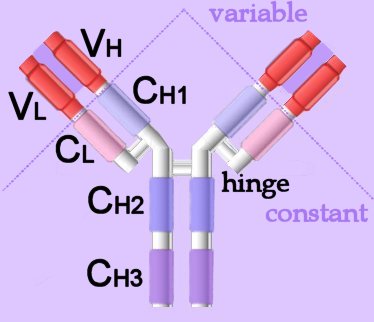
Immunoglobulins (left - click to enlarge) comprise two heavy (H) and two light-chain (L) protein subunits, each of which folds into domains (4 on heavy, 2 on light). These adhesion sites or domains contain one or more folds of 60 to 100 amino acids.

Depending upon the character of the heavy chain, immunoglobulins are divided into five classes – IgG, IgD, IgE, IgA, IgM – that are expressed in different tissues (detail). The classes are further subdivided into isotypes, which have different properties in terms of complement fixation and binding affinity to immunoglobulin (Ig) receptors.

Immunoglobulins can be divided into five different classes, based on differences in the amino acid sequences in the constant region of the heavy chains. All immunoglobulins within a given class will have very similar heavy chain constant regions. These differences can be detected by sequence studies or more commonly by serological means (i.e. by the use of antibodies directed to these differences).
1. IgG - γ - Gamma heavy chains
2. IgM - μ - Mu heavy chains
3. IgA - α - Alpha heavy chains
4. IgD - δ - Delta heavy chains
5. IgE - ε - Epsilon heavy chains

As adhesion-signaling molecules, immunoglobulins act as B-cell receptors (BCR) that recognize (ligate) specific antigens. The B cell receptor (BCR) is an integral membrane protein complex that is composed of two Ig heavy chains, two Ig light chains and two heterodimers of Ig-α and Ig-β. Antigens bind with greatest affinity to their cognate Ig-antibody, and hence to activated the BCR of greatest affinity.

Antigen-activated B cells proliferate and differentiate into memory B cells or plasma cells. B cell development is a tightly controlled process in which over 75% of the developing cells become apoptotic because of inappropriate immunoglobulin gene rearrangements or recognition of self antigens by Igs. Copious amounts of monoclonal antibodies are synthesized by antigen-stimulated B cell-derived plasma cells, while memory B cells remain primed for rapid activation by a repeat encounter with the initial, diffentiation activating antigen.

The enormous diversity of immunoglobulin molecules is attributable to VDJ recombination, while secondary antibody diversification is engineered by AID-induced/UNG2 assisted somatic hypermutation (SHM) or class-switch recombination (CSR), and AID-induced gene-conversion (GC). Affinity maturation is achieved are somatic hypermutation and clonal selection, which together ensure that repeated exposures to the same antigen will provoke greater antibody ligating affinity in the antibody secreted by successive generations of plasma cells.

tags

Labels: , , , , , , ,

| 0 Guide-Glossary

. . . since 11/21/06